How Does AI (Einstein GPT) Change Salesforce Job Roles?
- Dec 16, 2025
- 5 min read
Artificial Intelligence is no longer a future concept in Salesforce. It is already reshaping how professionals work, make decisions, and build solutions. With the introduction of Einstein GPT, Salesforce has moved from basic automation to intelligent assistance across CRM workflows. This shift directly impacts Salesforce job roles, skills, and career paths.
If you are enrolled in a Salesforce course, planning for salesforce certification training, or exploring salesforce training with placement, understanding how Einstein GPT changes Salesforce roles is no longer optional. It is essential for staying job-ready.
This guide explains how AI transforms Salesforce roles, what new skills are required, and how professionals can adapt through structured salesforce training classes, salesforce certification courses, and hands-on learning.
What Is Einstein GPT in Salesforce?
Einstein GPT is Salesforce’s generative AI capability that combines CRM data with large language models to deliver AI-powered content, insights, and automation directly inside Salesforce workflows.
Einstein GPT helps users:
Generate emails, case summaries, and reports
Predict customer behavior
Automate repetitive tasks
Provide real-time recommendations
Improve decision-making using CRM data
Unlike traditional AI tools, Einstein GPT works inside Salesforce, using trusted customer data securely.

Why Einstein GPT Matters for Salesforce Careers
AI adoption is changing how companies hire Salesforce professionals. Organizations now expect professionals to work with AI-powered tools, not just configure Salesforce objects.
According to industry reports:
CRM roles using AI see higher productivity gains
Salesforce professionals with AI skills earn higher salaries
AI-enabled CRM adoption grows year over year
This change affects every role, from admin to developer to consultant. That is why modern Sfdc training and salesforce trainings now include AI concepts.
Salesforce Job Roles Before and After Einstein GPT
Before Einstein GPT
Salesforce roles focused on:
Manual data entry
Rule-based automation
Static reporting
Reactive customer support
Fixed workflows
After Einstein GPT
Salesforce roles now focus on:
AI-assisted decision-making
Predictive analytics
Automated content creation
Proactive customer engagement
Intelligent workflow optimization
This shift changes daily responsibilities and skill expectations.
How Einstein GPT Changes the Salesforce Admin Role
Traditional Salesforce Admin Responsibilities
User management
Data maintenance
Workflow rules
Reports and dashboards
Security configuration
AI-Driven Salesforce Admin Responsibilities
With Einstein GPT, admins now:
Configure AI-driven workflows
Manage AI-generated insights
Validate AI outputs for accuracy
Monitor data quality for AI models
Enable intelligent automation
Admins move from task execution to system oversight.
New Skills for Salesforce Admins
Understanding AI predictions
Data quality management
Prompt-based AI interaction
Workflow optimization using AI
Ethical AI awareness
A modern salesforce admin certification course now prepares learners for this AI-powered admin role.
How Einstein GPT Transforms Salesforce Developer Roles
Before AI Integration
Developers focused on:
Apex coding
Triggers and workflows
UI customization
Integration logic
After Einstein GPT
Developers now:
Use AI to generate code suggestions
Build AI-driven automation
Integrate predictive models
Optimize performance using AI insights
Focus on architecture over manual coding
Example: AI-Assisted Apex Logic
// AI-assisted suggestion logic
if (Opportunity.Amount > predictedRevenue) {
    sendAlert();
}
AI reduces repetitive coding and increases solution quality.
Developers who complete advanced salesforce certification courses gain an edge by combining coding skills with AI understanding.
How Einstein GPT Changes Salesforce Consultant Roles
Traditional Consultant Work
Requirement gathering
Solution design
Manual configuration
User training
AI-Enhanced Consultant Work
With Einstein GPT, consultants:
Use AI to analyze business data
Predict customer behavior
Design intelligent CRM strategies
Guide AI adoption for clients
Train users on AI-assisted workflows
Consultants now act as AI advisors, not just system builders.
This makes structured salesforce trainings critical for career growth.
Impact of Einstein GPT on Salesforce Business Analyst Roles
Business analysts benefit heavily from AI.
Key Changes
Faster data insights
Automated report summaries
Predictive trend analysis
AI-assisted recommendations
Example Use Case
A business analyst can use Einstein GPT to:
Identify churn risk customers
Predict sales pipeline gaps
Suggest process improvements
This reduces manual analysis time and increases decision accuracy.
How Einstein GPT Changes Salesforce Marketing Roles
Before AI
Manual campaign creation
Static customer segmentation
Delayed insights
After AI
AI-generated campaign content
Predictive customer targeting
Real-time performance insights
Personalized messaging at scale
Marketing professionals using Salesforce must now understand AI-driven CRM features.
How Einstein GPT Affects Salesforce Sales Roles
Sales roles see immediate impact.
AI-Powered Sales Features
Lead scoring predictions
Opportunity forecasting
Email drafting assistance
Deal risk alerts
Result
Sales teams close deals faster with fewer errors.
Salesforce professionals trained through Salesforce training with placement programs gain hands-on exposure to these tools.
New Salesforce Job Roles Created by AI
Einstein GPT does not remove jobs. It creates new ones.
Emerging Roles
Salesforce AI Admin
CRM AI Consultant
Salesforce Data Intelligence Specialist
AI Workflow Architect
AI Ethics and Compliance Analyst
These roles combine CRM expertise with AI knowledge.
Skills Required to Stay Relevant in AI-Driven Salesforce Careers
To succeed in AI-powered Salesforce roles, professionals need:
Technical Skills
Salesforce configuration
AI fundamentals
Data management
Automation logic
CRM analytics
Functional Skills
Business process understanding
Decision-making support
AI output validation
User training
Soft Skills
Communication
Problem-solving
Adaptability
Continuous learning
This is why updated salesforce certification training is critical.
How Salesforce Training Must Change in the AI Era
Traditional training is no longer enough.
Modern salesforce training classes now include:
AI concepts and use cases
Hands-on AI workflows
Real-world business scenarios
Prompt engineering basics
Data-driven decision-making
A complete Salesforce course prepares learners for AI-integrated roles, not just certifications.
Step-by-Step: How Learners Can Prepare for AI-Driven Salesforce Roles
Step 1: Build Salesforce Core Knowledge
Start with:
CRM fundamentals
Salesforce objects and data models
Security and workflows
Step 2: Learn AI Basics
Understand:
What AI does
How predictions work
AI limitations
Step 3: Practice AI Use Cases
Work on:
AI-driven reports
Predictive dashboards
Automated workflows
Step 4: Earn Certification
Enroll in structured salesforce certification courses aligned with AI skills.
Step 5: Gain Real-World Experience
Hands-on projects improve job readiness and confidence.
Real-World Example: AI in Salesforce Customer Support
A support team uses Einstein GPT to:
Auto-summarize cases
Suggest next-best actions
Predict case escalation risk
Result:
Faster resolution
Improved customer satisfaction
Reduced agent workload
This example shows why AI skills are now essential for Salesforce roles.
Why Employers Prefer AI-Ready Salesforce Professionals
Hiring managers now look for:
AI awareness
Practical CRM experience
Certification with hands-on exposure
Problem-solving ability
Candidates trained through industry-focused Sfdc training stand out in interviews.
Role of Structured Training in Career Growth
Self-learning alone is not enough.
Structured programs offered by H2K Infosys focus on:
Real-world Salesforce projects
AI-enabled CRM workflows
Job-oriented learning paths
Interview-focused preparation
This approach bridges the gap between certification and employment.
Common Myths About AI and Salesforce Jobs
Myth 1: AI Will Replace Salesforce Jobs
Reality: AI changes jobs, not removes them.
Myth 2: Only Developers Need AI Skills
Reality: Admins, consultants, and analysts all use AI.
Myth 3: AI Is Too Complex to Learn
Reality: AI tools in Salesforce are user-friendly when learned correctly.
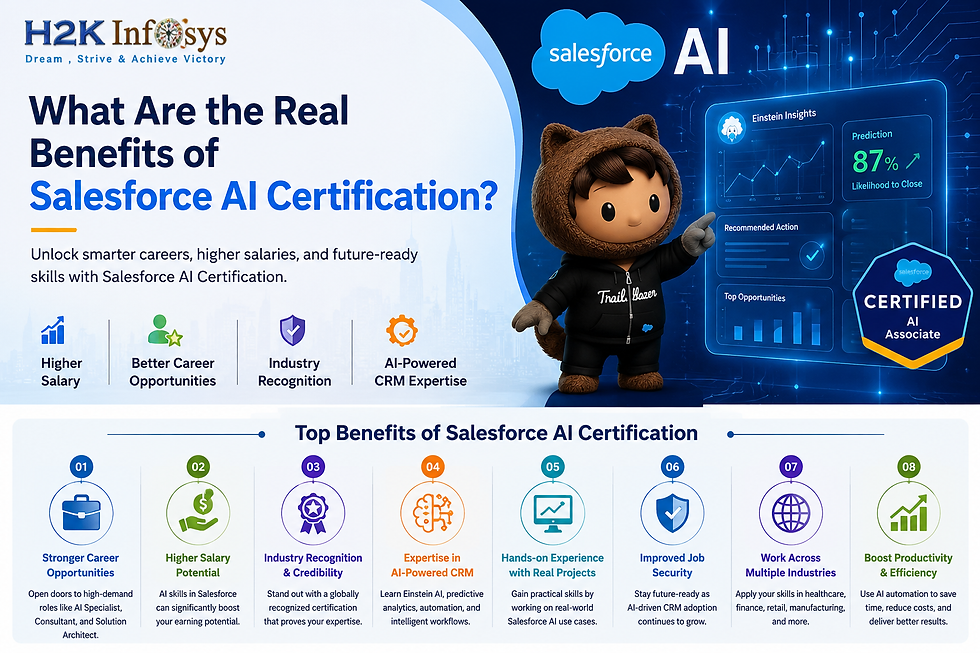
Key Benefits of Learning AI-Enabled Salesforce Skills
Higher salary potential
Faster career growth
Better job stability
Stronger problem-solving ability
Increased demand across industries
This makes AI-focused salesforce trainings a smart career investment.
Key Takeaways
Einstein GPT changes how Salesforce professionals work
Every Salesforce role now interacts with AI
AI creates new job roles and opportunities
Updated skills are essential for career growth
Structured training ensures job readiness
Conclusion
AI is reshaping Salesforce careers, and Einstein GPT is leading this change. Professionals who adapt early will secure better roles and long-term growth through the right Salesforce course and hands-on learning.
Start building AI-ready Salesforce skills today with expert-led training from H2K Infosys and move confidently toward a future-proof career.


Comments