What Skills Can I Gain from a Salesforce Course Online?
- Sep 30, 2025
- 5 min read
Introduction: Why Salesforce Skills Matter in 2025
Picture this: You walk into a company where every department sales, marketing, customer service, and IT runs seamlessly on one platform. Data flows smoothly, customer insights are crystal clear, and sales teams hit targets faster than ever. That’s the power of Salesforce, the world’s leading CRM (Customer Relationship Management) solution.
For professionals, this creates a golden opportunity. The demand for Salesforce talent continues to grow across industries, making it one of the most reliable career paths in IT and business. By enrolling in Salesforce training and placement programs, you gain not just theoretical knowledge but also hands-on skills that employers look for.
But what exactly can you expect to learn from a Salesforce course online? Let’s explore the essential skills you’ll gain and how they can transform your career.

1. Strong Foundation in Salesforce Basics
Every Salesforce journey begins with a deep dive into CRM fundamentals. A structured salesforce course introduces you to the Salesforce ecosystem, its cloud architecture, and its powerful suite of products.
What you’ll learn:
Understanding CRM and its role in modern businesses
Navigating Salesforce Lightning and Classic interfaces
Customizing dashboards and layouts
Creating, managing, and tracking leads, opportunities, and accounts
For example, consider a retail company using Salesforce to track customer purchases. With the skills gained in salesforce admin training, you’ll know how to design dashboards that instantly show top-selling products and seasonal buying trends.
2. Salesforce Administration Skills
One of the key outcomes of salesforce admin certification training is mastering administration tasks. Admins act as the backbone of any Salesforce instance, ensuring that the system supports the business’s unique needs.
Core admin skills include:
User management: roles, profiles, and permissions
Security model setup: ensuring safe data access
Workflow automation: rules, approvals, and processes
Data management: importing, exporting, and deduplication
In real-world terms, if a company has sales reps across different regions, you’ll know how to configure role hierarchies so that managers see only their team’s performance metrics.
3. Data Management and Analysis
Data is the heart of Salesforce. A robust salesforce course online trains you to manage, clean, and interpret data for business insights.
Practical skills gained:
Working with reports and dashboards
Building custom report types
Using formulas for calculated fields
Exporting data for advanced analysis
Imagine presenting a dashboard that highlights customer churn risk using visual charts. This data-driven insight helps businesses make proactive decisions—an ability that employers highly value.
4. Automation with Salesforce Tools
Automation is what makes Salesforce a game-changer. Courses prepare you to build workflows that save time and boost productivity.
Key automation tools you’ll master:
Process Builder for automating multi-step workflows
Flow Builder for advanced visual automation
Validation rules for ensuring data quality
Approval processes to streamline decision-making
For instance, when a lead reaches a certain score, Salesforce can automatically assign it to the right sales rep and trigger a follow-up email all configured by a Salesforce-trained professional.
5. Advanced Customization Skills
Every business is unique, and Salesforce’s strength lies in its flexibility. With salesforce admin training, you’ll gain skills to customize Salesforce without writing code.
Customization areas include:
Page layouts and record types
Custom fields and objects
Lightning App Builder for custom apps
UI enhancements for better usability
Think of a healthcare company that needs custom objects for patient records. You’ll be equipped to design those objects, define fields, and connect them to other modules.
6. Understanding Salesforce Clouds
Most salesforce admin courses cover the core Salesforce platform, but they also introduce specialized clouds.
You’ll explore:
Sales Cloud: lead, opportunity, and pipeline management
Service Cloud: customer service automation and case management
Marketing Cloud: personalized campaigns and automation journeys
Commerce Cloud: managing online sales and customer engagement
A banking professional, for example, can use Service Cloud to handle loan application queries, ensuring faster resolution and better customer satisfaction.
7. Integration Skills
No system works in isolation today. That’s why salesforce courses also teach you about integrations.
Key skills:
Connecting Salesforce with Outlook or Gmail
Syncing with ERP systems like SAP
API basics for custom integrations
Using AppExchange to install third-party apps
For example, integrating Salesforce with Slack allows instant notifications when a big deal closes improving team collaboration.
8. Hands-On Problem-Solving and Projects
The best salesforce training online emphasizes real-world projects. You don’t just learn concepts you apply them.
Project examples:
Setting up a sales pipeline for a mock company
Designing a customer support system with Service Cloud
Building automation for invoice approval
Creating dashboards for quarterly revenue reporting
These hands-on projects simulate real business challenges and prepare you for actual job roles.
9. Communication and Collaboration Skills
While technical skills are crucial, soft skills also play a big role. Through salesforce training and placement programs, you’ll practice:
Explaining technical configurations to non-technical stakeholders
Collaborating with developers and business analysts
Gathering requirements from end users
Translating business needs into Salesforce solutions
This balance makes you an asset to any team.
10. Preparing for Certification Exams
A structured course prepares you for Salesforce certifications that boost your resume. The most common is the Salesforce Administrator certification.
You’ll learn how to:
Review official exam objectives
Practice with mock tests and quizzes
Identify knowledge gaps for revision
Gain confidence through simulated exam environments
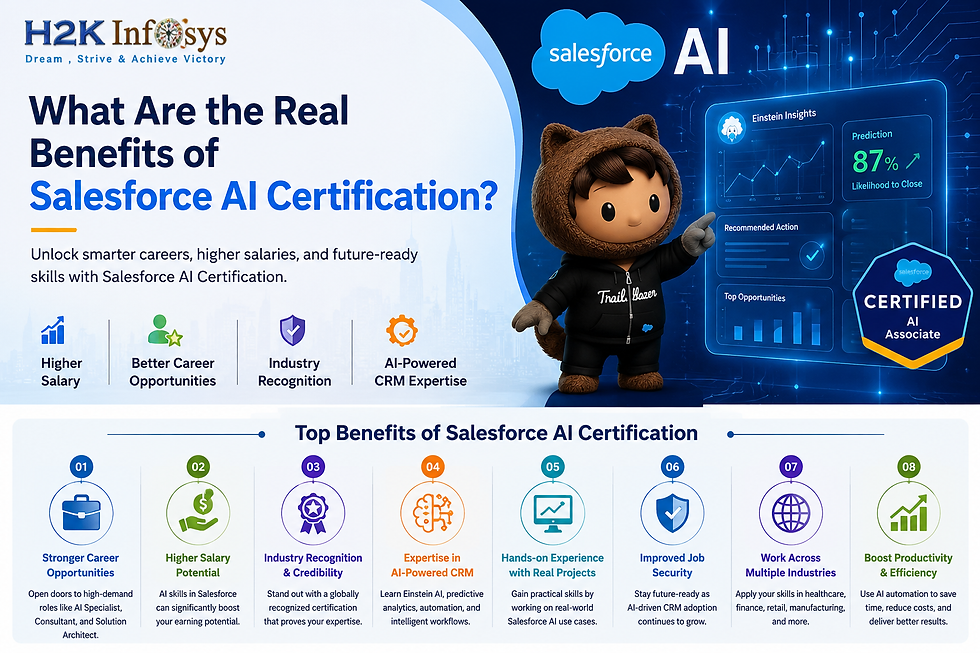
Certified admins often command higher salaries, and employers view certification as proof of job-ready expertise.
11. Career-Ready Skills for Placement
The ultimate goal of a salesforce training and placement program is employability. By the end of the course, you’ll have:
A portfolio of real projects
Hands-on system configuration skills
The ability to solve business challenges with Salesforce
Industry-recognized credentials (certifications)
These make you ready for roles like Salesforce Administrator, CRM Analyst, or Business Systems Consultant.
12. Awareness of Salesforce Career Costs and ROI
Another crucial part of your learning journey is understanding salesforce training cost and the return on investment.
Key takeaways:
Costs vary depending on the course type and depth.
Certification exams require separate fees.
Placement-focused programs deliver high ROI by connecting you to recruiters.
According to research, Salesforce professionals in the U.S. earn average salaries between $80,000–$120,000 annually. This makes the upfront investment in training well worth it.
13. Real-World Industry Applications
The skills from salesforce admin certification training are applicable across industries.
Healthcare: Track patient journeys, manage insurance claims.
Finance: Automate loan processes and customer support.
Retail: Manage inventory, sales campaigns, and loyalty programs.
Technology: Support agile sales teams with real-time analytics.
By mastering these applications, you become valuable to organizations across sectors.
14. Step-by-Step Skill Growth in an Online Salesforce Course
A typical course follows a structured journey:
Introduction to CRM and Salesforce basics
Administration skills and security setup
Automation with workflows and flows
Data management and reporting
Customization with objects and layouts
Cloud modules overview
Integration basics
Projects and case studies
Exam preparation
Placement assistance
This progression ensures learners of all levels gain confidence step by step.
15. Why Choose Online Salesforce Training?
An Online Salesforce course offers flexibility, affordability, and accessibility. Unlike classroom learning, you can balance work, family, and study.
Benefits include:
Learn at your own pace
Access recorded sessions for revision
Join live doubt-clearing sessions
Network with peers globally
Institutes like H2K Infosys also provide salesforce admin training with placement support, helping learners transition into full-time roles.
16. The Role of Placement Assistance
While skills are critical, career transition often requires guided support. Reputed training providers like H2K Infosys offer:
Resume building tailored for Salesforce jobs
Mock interviews with industry experts
One-on-one mentorship
Direct connections with hiring partners
This extra support ensures you don’t just learn Salesforce—you launch a successful career.
Conclusion: Skills that Transform Your Career
A salesforce course online equips you with everything from CRM fundamentals and admin expertise to automation, customization, data analytics, and integration skills. You also gain communication, problem-solving, and project execution abilities making you industry-ready.
With the best Salesforce training online, you’ll unlock opportunities in multiple industries and secure high-paying, future-proof roles.
Start your Salesforce journey today master the skills, earn your certification, and step into one of the fastest-growing careers in tech.


Comments